

Introduction
In today’s digital landscape, your local business’s visibility across Google is more important than ever. But it’s not just about ranking in traditional search results anymore. With AI taking a bigger role in search, businesses need to optimize for AI’s understanding as much as they do for classic SEO.

What does this mean for your business?
In this post, we’ll break down how structured data (schema) is the secret ingredient to enhance your visibility on Google and beyond, especially as AI systems like ChatGPT become a more common way people search for information.
Learn more about AI’s role in SEO at Search Engine Land.
Key Question: Are you adding schema to help search engines better understand your business?
What Is Schema? Why Should You Care?
To kick things off, let’s simplify it. Schema refers to the structured data markup you add to your site to help search engines understand the context of your content. Imagine it as giving your website a “cheat sheet” so that Google can better grasp your content and what your business is all about.
- Why does this matter?
Google uses schema as a way to verify your information and align it across multiple channels, helping it confidently decide what data to surface to users. Without schema, Google might guess wrong about what your business does, which could lower your visibility.
Key Question: Are you adding schema to help search engines better understand your business?
How Google Uses Schema for Local Visibility
Google’s AI and algorithms have evolved to prioritize relevant and accurate data. Structured data plays a key role in how your business is understood and presented across search results, including knowledge panels, local packs, and rich results.
Here’s how Google uses schema for local visibility:
- Data Verification: Schema helps Google cross-check business info across your website, Google Business Profile (GBP), reviews, and citations.
- Contextual Understanding: Instead of just relying on keywords, Google uses schema to understand the context — for example, the type of service you offer, business hours, or location.
- Enhanced AI Answering: AI systems, like Google’s assistant or even third-party AI tools, can pull schema-marked data to answer user queries with confidence.
Types of Schema That Matter Most for Local SEO
To maximize your local visibility, it’s essential to use the right types of schema that align with your business type and location. Below, we’ll explore the most important schema markups for local businesses.
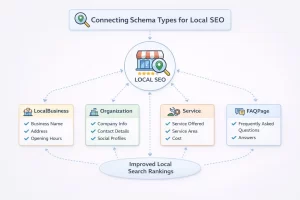
1. LocalBusiness Schema
This one’s a no-brainer. It’s the most important schema for local businesses because it directly defines your business and location for Google and other search engines.
Key Elements:
- Business Name
- Address (with geolocation)
- Business Hours
- Phone Number
- Website URL
Read more about the importance of LocalBusiness Schema on Search Engine Land.
Pro Tip: Ensure your schema matches your Google Business Profile for maximum impact.
2. Organization Schema
For businesses with multiple locations or a broader brand presence, Organization schema is crucial. It establishes your entity’s parent-child relationship (e.g., a chain of stores) and links your local business to the overarching brand.
What to include:
- Brand Name
- Logo
- SameAs (link to social media)
Example:
- Schema Type: Organization
- Disambiguation: “XYZ Dental Group | Regional Leader in Dental Services”
3. Product and Service Schema
Even if your business isn’t selling physical products, using a service schema helps define the services you offer. This is especially important for service-based businesses like lawyers, doctors, and consultants.
Example:
A dentist could use a service schema for teeth whitening or root canal services.
4. FAQ Page Schema
Including FAQ schema helps your site appear in rich snippets, especially when users ask common questions related to your business. FAQs help increase your chances of appearing in AI-generated answers.
Why Schema Alone Doesn’t Guarantee Rankings (And How To Avoid Common Mistakes)
One thing to keep in mind: Schema doesn’t directly impact rankings. It’s a tool that helps Google and AI systems understand your business — but if the data is inconsistent or incorrect, it can hurt your visibility.
Common Schema Mistakes to Avoid:
- Conflicting Data: Schema data that conflicts with your business’s actual details (e.g., business hours or staff listings).
- Overuse or Misuse: For example, using person schema for someone who’s not actually a staff member.
- Ignoring Updates: Outdated schema (e.g., old services or hours) can lead to mistrust from Google’s AI systems.
How to Keep Your Schema Up-to-Date
It’s not a “set and forget” game — you need to regularly audit your schema to ensure that everything remains consistent and up-to-date.
Tips for Maintaining Accurate Schema:
- Quarterly Audits: Make sure your business hours, staff details, and services are all reflected in your schema.
- Automate Updates: If your business frequently changes services or locations, use automation tools to keep your schema accurate.
- Align Schema with Google Business Profile: Regularly cross-check and update schema data to match your GBP.
Real-World Example: Schema in Action for Local Businesses
Scenario: Let’s say you run a local restaurant. By using the Restaurant schema alongside your GBP and other local citations, Google can confidently present your business in local packs, knowledge panels, and voice search results.
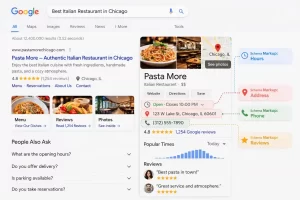
Table: Benefits of Schema for Your Local Business
| Schema Type | Benefits | Example Use Case |
| LocalBusiness Schema | Helps define business, location, and contact info | Restaurant, Law Firm |
| Organization Schema | Strengthens brand presence and entity relationship | Chain of stores |
| Service Schema | Makes services easy for AI to understand and present | Dentist, Consultant |
| FAQPage Schema | Increases chances of appearing in rich snippets | Restaurants, Hotels |
The Future of Local SEO: AI and Schema Integration
With AI advancing rapidly, it’s clear that businesses that leverage schema effectively will have a competitive edge. Why? AI systems are relying more on structured data to pull relevant, trusted business info. If your schema is inconsistent or missing, it’s like leaving a digital footprint behind — one that could hurt your local search visibility.

What’s Next for Schema and Local SEO?
- AI Expansion: As AI tools like ChatGPT and Google Assistant evolve, schema will become an even more essential tool for local businesses.
- Cross-Platform Consistency: Ensure your schema aligns across Google, social media, and third-party platforms for maximum coverage.
Optimizing Schema for Local SEO in 2026
Schema may not directly improve your search rankings, but it helps Google understand you better — and in today’s world of AI, that’s a huge advantage. To stay competitive in the ever-changing digital marketing landscape, keep your schema updated, aligned with other platforms, and consistent with your messaging across the web. If you do that, you’ll enhance your local visibility in ways that Google’s AI can’t ignore.
Discover more on how schema impacts local SEO and AI at Search Engine Land.
Are you ready to give your business the visibility it deserves? Start optimizing your schema today or reach out to us.